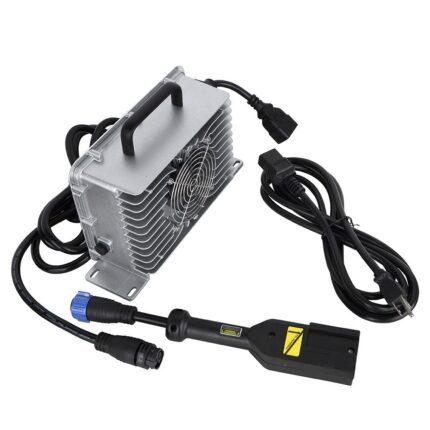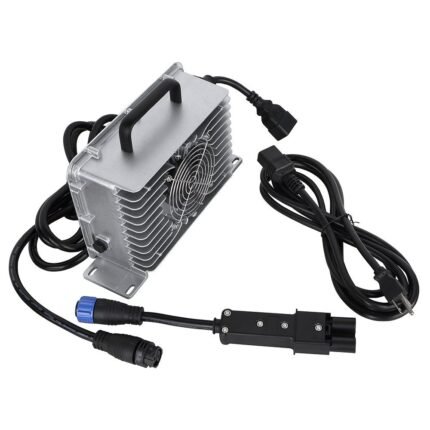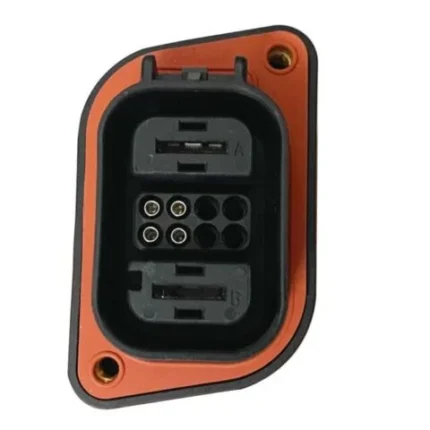

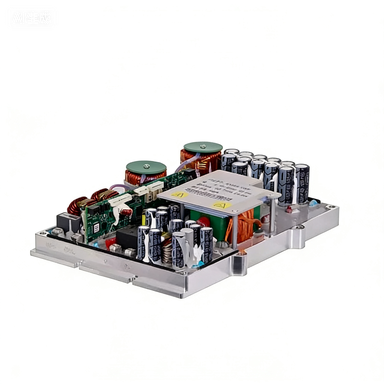
6.6KW On-Board Charger (OBC) for Electric Vehicles
High-Efficiency AC-DC Converter OBC (90Vac–256Vac) for EVs: Key Functions & Applications
1. Core Functions
- Voltage Step-Down: Converts high-voltage traction battery power (90Vac–256Vac) to stable 250Vdc–470Vdc.
- Energy Efficiency: Typically achieves >94% efficiency (LLC resonant topology).
- Safety & Protection: Overvoltage, overcurrent protection, and isolation monitoring.
Technical Specifications
| Technical Specification | Value |
|---|---|
| Input Voltage | 90Vac–256Vac |
| Output Voltage | 250Vdc–470Vdc |
| Max Output Current | 21A |
| Rated Power | 6.6KW |
| Maximum Power | 6.6KW |
| Peak Efficiency | >94% |
| Protection Rating | IP20 (Water-Cooling) |
| Communication Interface | CAN 2.0 |
| Dimensions (L×W×H) | 288×200×64 mm |
| Unit Weight | 5 kg |
2. What is OBC and Why Choose 6.6KW OBC?
An On-Board Charger (OBC) is a critical component in electric vehicles (EVs) that converts alternating current (AC) from the grid (e.g., home chargers, public stations) into direct current (DC) to recharge the vehicle’s high-voltage battery.
Key Functions
- AC-to-DC Conversion: Transforms grid AC (e.g., 110V/220V) to battery-compatible DC (e.g., 250–450V).
- Charging Control: Manages voltage/current to optimize battery health and efficiency.
- Safety Protocols: Includes overvoltage/overcurrent protection and isolation monitoring.
2.1 Why Choose 6.6KW OBC?
A 6.6KW OBC offers the ideal balance of speed, cost, and compatibility for most EVs. Here’s why it’s the industry standard:
1. Faster Charging vs. Lower Power Options
| OBC Power | Charging Time (0→100% for 60kWh Battery) | Use Case |
|---|---|---|
| 3.3KW | ~18 hours | Low-cost EVs / slow overnight |
| 6.6KW | ~9 hours | Mainstream EVs (e.g., Nissan Leaf) |
| 11KW+ | ~5.5 hours | Premium / long-range EVs |
Example: A 6.6KW OBC adds ~40km range per hour (vs. 20km at 3.3KW).
2. Cost-Effectiveness
- Infrastructure Compatibility: Works with widespread Level 2 AC chargers (208–240V, 30A circuits).
- Lower Upfront Cost: 11KW+ OBCs require expensive 3-phase power and heavier cables.
3. Thermal & Weight Efficiency
- Heat Management: 6.6KW generates less heat than 11KW+ units, reducing cooling needs.
- Space-Saving: Lighter/smaller than high-power alternatives (e.g., Tesla’s 11KW OBC weighs 2× more).
4. Market Standardization
- Adopted by Major OEMs: Nissan, Chevrolet, Hyundai use 6.6KW for mass-market models.
- Aftermarket Support: Easier to replace/upgrade due to broad compatibility.
2.2 When to Choose Higher/Lower Power?
- 3.3KW: Budget EVs / short-range urban vehicles (e.g., Wuling Hongguang Mini EV).
- 11KW+: Luxury / long-range EVs (e.g., Tesla Model S) with 3-phase power support.
3. Key Technical Keywords
- “6.6KW OBC”
- “On-Board Charger 6.6KW”
- “EV Charger 6.6KW”
- “AC-DC Converter for Electric Vehicles”
- “Level 2 EV Charging Module”