

Blog
48V to 12V DC-DC Converter: Top Picks for Golf Carts, Solar Systems, and EVs

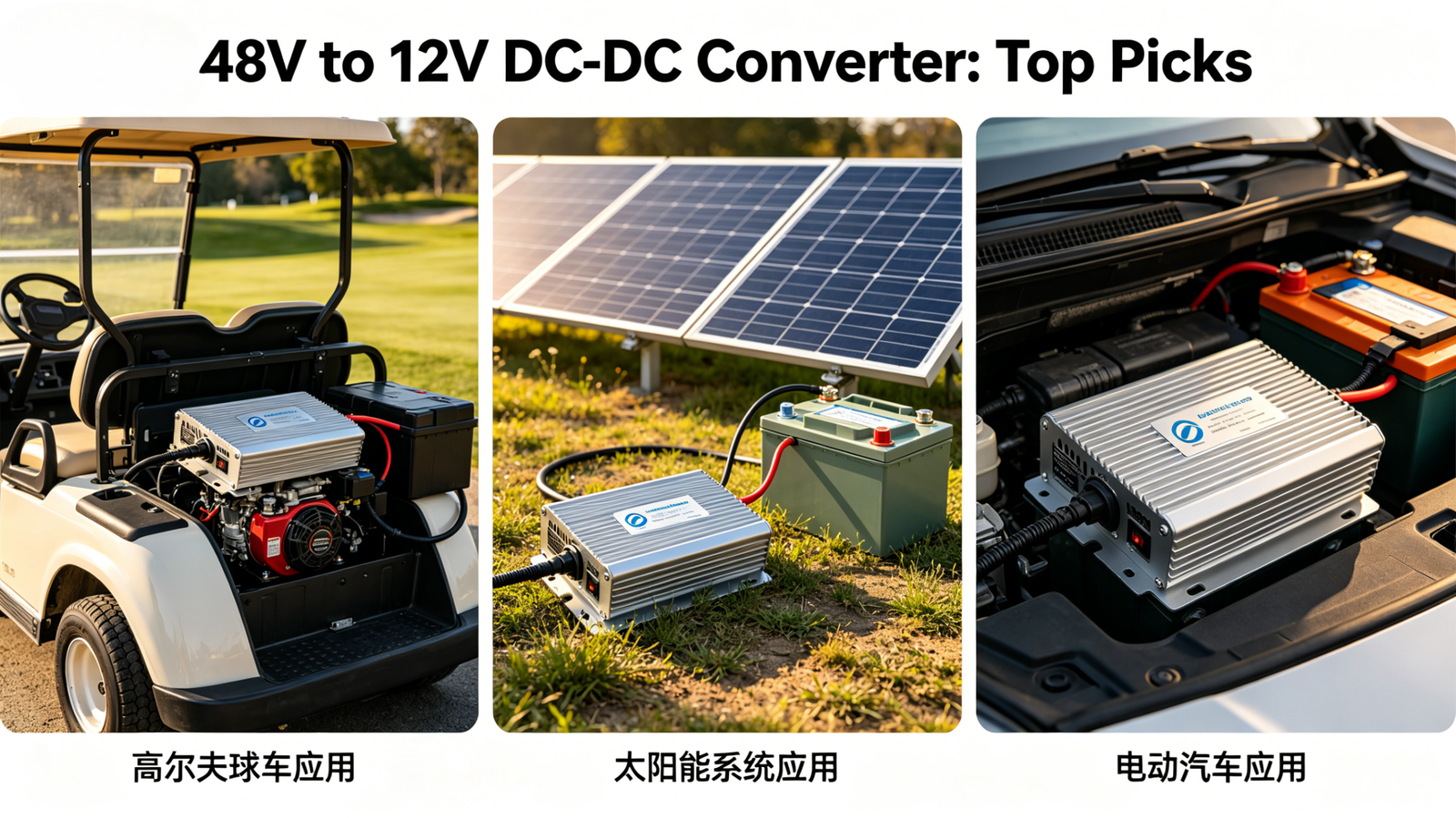
48V to 12V DC-DC Converter: Top Picks for Golf Carts, Solar Systems, and EVs
48V to 12V DC-DC Converter: Top Picks for Golf Carts, Solar Systems, and EVs
📅 Updated: April 2026 | ⏱ 12 min read | 🔋 DC-DC Conversion
As 48V systems become increasingly common in golf carts, off-grid solar installations, and electric vehicles, the need for reliable 48V to 12V DC-DC converters has never been greater. These essential components step down higher voltage battery banks to a stable 12V output, powering everything from LED headlights and USB chargers to navigation systems and auxiliary electronics. But with so many options on the market—ranging from basic voltage reducers to advanced bidirectional converters—how do you choose the right one? This guide breaks down the best 48V to 12V step-down converters for golf carts, solar systems, and EVs, along with key selection criteria and installation tips.
Why You Need a 48V to 12V DC-DC Converter
A 48V to 12V converter (also called a step-down converter, buck converter, or voltage reducer) is a DC-DC power supply that converts a higher input voltage (typically 36V–60V) into a regulated 12V DC output. A 48V to 12V DC-DC converter is a buck regulator using PWM control to reduce voltage while maintaining ≥85% efficiency[reference:0]. Without it, any 12V accessory connected directly to a 48V battery would be instantly destroyed. Whether you’re adding lights to a golf cart, powering a 12V fridge in an off-grid cabin, or running sensors in an electric vehicle, a quality 48v to 12v reducer is essential for safety and performance[reference:1].
💡 Quick fact: 48V power architectures deliver the same power as 12V systems using lower current, which dissipates less heat in wire harnesses and bus bars, making 48V the preferred choice for high-power-density applications[reference:2].
Top Picks for Golf Carts
Golf carts typically operate on 36V or 48V battery banks (six 6V or six 8V batteries). Adding 12V accessories like LED light bars, sound systems, USB ports, or fans requires a dedicated golf cart voltage reducer. The table below compares five top-rated 48V to 12V converters specifically designed for golf carts and RVs.
Product
Input Range
Output
Max Power
Key Features
dkplnt 20A 240W Converter
30–60V DC (36V/48V)
12V, 20A
240W
Up to 97% efficiency, overload protection, fuse included[reference:3]
Pro Chaser DC-DC 12V Regulator
36V–48V
12V, 20A
240W
Includes harness and connectors, compact design[reference:4]
KInuoxj 20A 240W DC-DC
20–60V DC (24/36/48V)
12V, 20A
240W
100% waterproof, aluminum shell with silicone seal[reference:5]
Nilight 360W 30A 12V Converter
36V–48V
12V, 30A
360W
Waterproof, anti-shock, high-efficiency design[reference:6]
Kewig 32A 400W 12V Converter
48V–120V
12V, 32A
400W
Smart protection, high efficiency up to 98%[reference:7]
🔧 Pro Chaser 20A 240W DC-DC Converter
Specifically designed for golf carts and RVs, this model supports 36V or 48V battery configurations and delivers a stable 12V output at up to 20A (240W). It comes with a matched harness and fitted butt connectors for straightforward installation, making it ideal for powering headlights, taillights, radios, and other accessories. Its compact form factor fits easily under dashboards or in tight compartments[reference:8].
⚡ dkplnt 20A 240W Golf Cart Converter
This converter accepts a broad input range from 30V to 60V DC, accommodating both 36V and 48V systems. It features high conversion efficiency rated up to 97%, minimizing heat and maximizing battery life during extended use. Built-in protections against overload, over-current, over-temperature, and short circuits enhance reliability in demanding environments[reference:9].
Top Picks for Solar Systems
Off-grid solar systems often use 48V battery banks (common with LiFePO₄ and lead-acid configurations) to minimize current and cable losses. A 48v to 12v step down converter is required to power 12V DC loads such as LED lighting, USB outlets, fans, communication equipment, and control panels.
🔋 Victron Energy Orion-Tr 48/12-30A (360W)
The Victron Energy ORI481240110 is a high-performance DC-DC converter designed to step down 48V DC input to a stable 12V DC output with a continuous output current of 30A. Rated at 360 watts, this converter is ideal for powering 12V equipment in off-grid solar setups, marine systems, and industrial environments. It utilizes advanced high-frequency switching technology to maintain up to 95% efficiency, even at high loads. The unit includes comprehensive electronic protections against over-voltage, short circuits, thermal overload, and reverse polarity. Installation is straightforward with clearly labeled screw terminals, and its compact, rugged construction withstands tough environmental conditions[reference:10].
Key specs: Input: 32–70V DC | Output: 12.2V fixed | Current: 30A | Efficiency: Up to 95% | Cooling: Passive (natural convection)[reference:11]
🌞 Nomadic Controls D1 – Robust DC to DC Converter
The Nomadic Controls D1 is a rugged, high-efficiency DC-DC converter engineered for vans, RVs, and off-grid electrical systems. It features bidirectional charging, intelligent voltage regulation, and automotive-grade protections. Whether stepping voltage up or down, the D1 delivers reliable 12V output from 24V or 48V sources—perfect for lithium battery systems, solar charging banks, or alternator-powered setups. With over 95% efficiency, an IP67-rated waterproof chassis, and compatibility with CAN (RVC) systems for real-time data monitoring, the D1 is built for demanding mobile power applications[reference:12].
Top Picks for Electric Vehicles (EVs)
In modern electric vehicles (EVs) and mild hybrid electric vehicles (MHEVs), 48V to 12V DC-DC converters play a critical role. Unlike traditional vehicles with alternators, EVs rely on a DC-DC converter to step down the high-voltage battery (typically 48V in MHEVs or much higher in full EVs) to charge the 12V auxiliary battery and power all 12V systems—lights, infotainment, wipers, sensors, and control modules[reference:13].
In MHEVs, a 48V-12V DC-DC converter links the 48V and 12V batteries, providing essential power flow between the medium and low voltage power nets. The end-user does not notice these modules, but they are indispensable for vehicle operation, as MHEVs do not have a traditional 12V alternator[reference:14][reference:15]. The current standard for MHEVs is to have two batteries, with a 48V-12V DC-DC converter linking them[reference:16].
🚗 Toshiba 3kW 48V-12V Bidirectional DC-DC Converter
This bidirectional DC-DC converter reference design enables voltage conversion between 12V and 48V battery systems in electric vehicles. It achieves high-efficiency operation using Toshiba’s automotive MOSFETs, which feature low on-resistance and high heat dissipation. Bidirectional converters are increasingly important as dual-voltage systems (12V and 48V buses) become more popular in modern automotive architectures. These converters can transfer energy in both directions, allowing regenerative energy to be stored efficiently and distributed where needed[reference:17][reference:18].
⚙️ Vicor DCM3735 48V to 12V DC-DC Converter
The Vicor DCM3735 achieves 96% efficiency and is widely used to convert 48V to 12V in various automotive subsystems, particularly in zone architectures. Its high power density and efficiency make it ideal for space-constrained EV applications[reference:19]. The lower set of switches are used for both the charge pump and the buck converter, allowing 48V to be converted to 12V or lower in a single conversion stage at high efficiency by adding an inductor. The output voltage is set by a single resistor[reference:20].
How to Choose the Right 48V to 12V Converter
When selecting a dc to dc converter 48v to 12v, consider these critical factors:
Power requirements: Calculate the total wattage of all 12V accessories you plan to run simultaneously. Choose a converter rated at 120% of your peak load—a 10A fridge compressor needs at least a 12A converter[reference:21].
Input voltage range: Ensure the converter supports your system’s voltage (e.g., 36V–60V for most golf carts and 48V solar systems). For automotive applications, look for converters rated for 60V+ inputs to handle voltage spikes up to 58V during regenerative braking[reference:22].
Efficiency: High-efficiency converters (≥90%) generate less heat and extend battery life. Premium models like Daygreen achieve 95% to 97.1% efficiency using zero-voltage switching[reference:23].
Isolated vs. non-isolated: Isolated DC-DC converters provide electrical separation between input and output, preventing ground loops in dual-battery systems. Non-isolated converters are simpler, more efficient, and suitable for most golf cart and solar applications where isolation isn’t required[reference:24].
Environmental protection: For outdoor or mobile use, look for waterproof (IP65 or IP67) and vibration-resistant enclosures. The D1 features an IP67-rated chassis, ready for water, dust, and road vibrations[reference:25].
Protection features: Overload, over-current, over-temperature, short-circuit, and reverse polarity protection are essential for safety and reliability. Prioritize converters with UL certification to avoid counterfeit units lacking surge protection[reference:26].
Installation and Safety Tips
Proper installation of a 48v to 12v step down converter is critical for safety and performance. Follow these guidelines:
Use a fuse-rated input line: Install an in-line fuse within 7 inches of the battery positive terminal to protect against short circuits. For 20A loads, use 14AWG wiring for runs under 3 feet[reference:27].
Ensure proper heat dissipation: Mount converters vertically with at least 5mm airflow gaps. Use aluminum heatsinks with ≥2mm fin thickness and apply thermal paste (≥3.5W/mK) between the module and heatsink. For solar installations, derate power by 20% in 35°C+ environments[reference:28].
Ground the chassis: Proper grounding reduces electrical noise and improves safety. In marine or mobile applications, waterproof Anderson connectors prevent corrosion[reference:29].
Verify polarity: Always double-check input and output connections with a multimeter before powering up to prevent reverse-voltage damage[reference:30].
Secure mounting: 80% of converter failures stem from vibration-induced solder cracks. Use rubber grommets when routing cables through metal panels[reference:31].
⚠️ Warning: Never connect 48V batteries directly to 12V loads—instant component burnout is almost certain[reference:32]. Also, never daisy-chain multiple converters; stacking cascades efficiency losses (85% × 85% = 72%). Use a single high-capacity unit instead[reference:33].
Frequently Asked Questions
Can I use a 48V to 12V converter to charge a 12V battery?
Yes, many converters can function as battery chargers if they feature adjustable output voltage (e.g., 13.5V or 14.6V for charging). However, the Victron Orion-Tr 48-12-30 is a DC-DC converter, not a charger—for battery charging, use an MPPT charge controller or a dedicated DC-DC charger[reference:34].
What is the difference between isolated and non-isolated 48V to 12V converters?
Isolated converters have electrical separation between input and output, preventing ground loops and offering enhanced safety in dual-battery systems. Non-isolated converters are simpler, more efficient, and suitable for most single-battery applications like golf carts and solar systems[reference:35].
How efficient are 48V to 12V converters?
Switching converters typically achieve 85–95% efficiency, with premium models reaching up to 98%. Linear regulators, in contrast, are only 40–50% efficient and not recommended for high-power applications[reference:36].
Are automotive 48V to 12V converters suitable for solar use?
Only if rated for 24/7 continuous operation—many automotive units overheat within 8 hours of continuous use. Always check the duty cycle rating[reference:37].
Conclusion: Power Your 48V System with Confidence
Whether you’re upgrading a golf cart with LED lights, building an off-grid solar system, or designing an electric vehicle power architecture, a quality 48V to 12V DC-DC converter is essential for safe and efficient operation. From budget-friendly 20A reducers to high-power bidirectional converters, the right choice depends on your power requirements, environmental conditions, and budget. Always prioritize efficiency, protection features, and proper installation to ensure years of reliable service. With the right converter, your 48V system can seamlessly power all your 12V accessories, wherever the road—or the trail—takes you.
© 2026 Power Electronics Guide – Your resource for 48v to 12v converter reviews, dc-dc step down converter comparisons, and mobile power solutions.