

Blog
Best 12V Power Inverters for Home Backup and Off-Grid Living in 2026

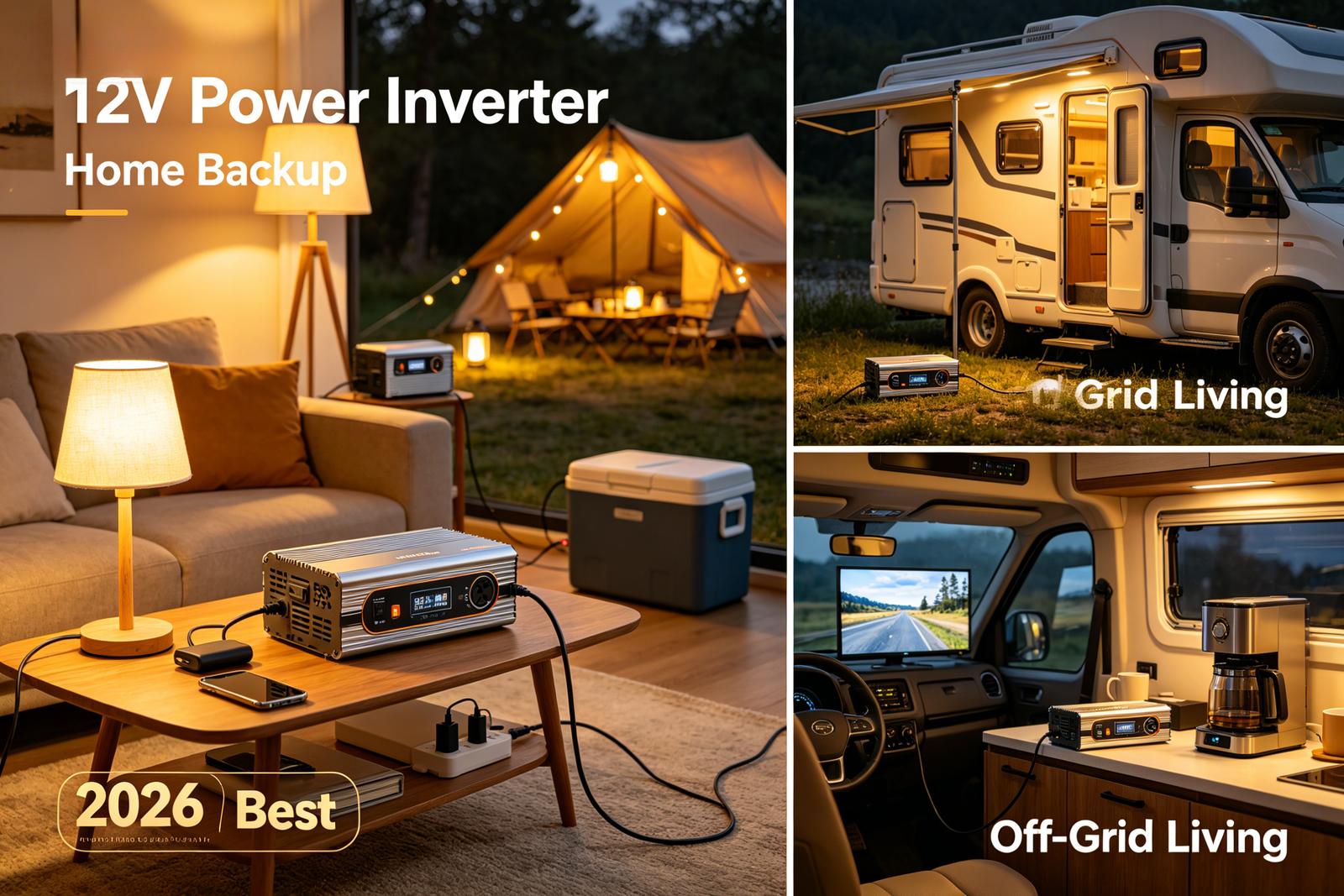
Best 12V Power Inverters for Home Backup and Off-Grid Living in 2026
Best 12V Power Inverters for Home Backup and Off-Grid Living in 2026
📅 Updated: April 2026 | ⏱ 12 min read | 🔌 Power Conversion
Whether you’re preparing for unexpected power outages or embracing a fully off-grid lifestyle, a reliable 12V power inverter is the heart of your energy system. These essential devices convert DC power from your battery bank into clean AC power, allowing you to run lights, refrigerators, laptops, and even power tools from a 12V battery. With so many options on the market—from compact 500W units to heavy-duty 6000W systems—choosing the right one can be overwhelming. In this guide, we’ll review the best 12V inverters for home backup and off-grid living in 2026, explain key features, and help you size your system correctly.
Why You Need a Pure Sine Wave Inverter for Home Backup
When it comes to powering sensitive electronics and modern appliances, the type of waveform your inverter produces matters greatly. There are two main categories: pure sine wave and modified sine wave. Pure sine wave inverters produce a smooth, utility-grade AC waveform with low total harmonic distortion (typically below 3%), making them compatible with virtually any device—from laptops and CPAP machines to variable-speed refrigerators and medical equipment. Modified sine wave inverters produce a stepped approximation of a sine wave with harmonic distortion of 20–30% and are only suitable for simple resistive loads like incandescent lights and heating elements[reference:0]. While modified sine wave models may save money upfront, their efficiency drops to about 80–85%, and they can cause motors to draw 10–20% more current, generate excess heat, and experience significantly higher startup stress[reference:1]. For home backup and off-grid living, always invest in a pure sine wave inverter. They last longer—by about 20 to 30 percent—and protect your valuable electronics[reference:2].
💡 Key Insight: Pure sine wave inverters provide clean, stable power that matches utility grid quality. They’re essential for running any device with a microprocessor, variable-speed motor, or sensitive power supply.
Top 12V Power Inverters for 2026
After extensive market analysis and user feedback, here are the best 12V inverters for home backup and off-grid applications in 2026.
🔋 Renogy 2000W Pure Sine Wave Inverter
Best Overall for Off-Grid
The Renogy 2000W continues to dominate the off-grid market with superior build quality and reliability. It delivers 2000W continuous power and 4000W surge capacity, features a UPS transfer switch that switches in just 15 milliseconds during outages (preventing pellet stove shutdowns), and includes built-in Bluetooth for remote monitoring. With 95% conversion efficiency, it’s perfect for RVers and off-grid enthusiasts needing quiet, reliable backup power.[reference:3][reference:4]
🏆 Victron Energy MultiPlus 12/1200
Premium Choice for Mission-Critical Systems
Victron is legendary for a reason—their inverters are virtually bulletproof and modular. The Phoenix 12/1200VE delivers 1200W continuous pure sine wave output with uncompromising power quality, making it ideal for sensitive electronic equipment. For full systems, the MultiPlus series combines a powerful sine wave inverter, sophisticated battery charger, and high-speed AC transfer switch in one compact housing. Best for residential off-grid and hybrid systems.[reference:5][reference:6]
⚡ Giandel 3000W Pure Sine Wave Inverter
Best Value for High Power
Giandel has pioneered high-frequency inverter solutions for over a decade. The 3000W model delivers 3000W continuous and 6000W peak power, features dual AC sockets and a high-speed silent cooling fan, and is ideal for campers, RV owners, and boaters who want to run household devices safely from a 12V battery. Compact, portable, and military-grade durable.[reference:7]
🏠 VEVOR 1500W Pure Sine Wave Inverter
Best Budget Option for Home Backup
VEVOR’s 1500W pure sine wave inverter is an excellent entry point for home backup. It features six ports (USB, AC, Type-C with fast charging), allowing you to power multiple devices at once. Perfect for mobile offices, RV camping, or as a reliable home backup power solution during outages. For larger needs, VEVOR also offers 2000W and 3000W models with integrated charger functionality.[reference:8][reference:9]
⚙️ AIMS Power 2000W Pure Sine Inverter
Most Feature-Rich with Strong Protection
AIMS Power inverters are known for being affordable yet packed with the best protection features. The 2000W model (4000W peak) converts 12V DC to 120V AC and is ETL Listed to UL 458. It’s ideal for small to medium-sized off-grid applications, RVs, and boats. AIMS offers a variety of voltage options to cater to diverse power needs, from 600W to 5000W models.[reference:10][reference:11]
🌊 Xantrex Freedom X 2000W Inverter
Best for Marine and RV Durability
Xantrex is a leading manufacturer for marine, RV, and trucking industries. The Freedom X 2000W inverter offers premium performance in a lightweight compact package and operates at full output from -4°F to 104°F. Features include automatic temperature compensation and ignition control. For larger systems, the Freedom XC Pro 3000W inverter/charger includes generator support mode and a remote control display.[reference:12][reference:13]
Inverter/Charger Combo Units: The All-in-One Solution
For home backup and serious off-grid systems, consider an inverter/charger combo. These units combine a pure sine wave inverter, a multi-stage battery charger, and an automatic transfer switch in a single device. When grid power is available, they pass it through to your loads while simultaneously charging your batteries. When an outage occurs, they automatically switch to inverter mode in milliseconds, providing seamless backup power. The Victron MultiPlus, Xantrex Freedom XC, and Renogy 3000W inverter/charger are excellent examples. VEVOR’s 3000W inverter charger even includes five smart working modes (AC Priority, Battery Priority, ECO, and Generator modes), making it ideal for RV travel, camping, and home backup.[reference:14][reference:15]
⚠️ Safety Note: Always ensure your inverter is properly fused and wired with appropriate gauge cables. For a 2000W inverter at 12V, you need at least 2/0 AWG cable and a 250A fuse within 18 inches of the battery positive terminal.
How to Size Your 12V Inverter for Off-Grid Living
Proper sizing is crucial for reliable operation. Follow these steps:
- List your devices: Write down every AC appliance you plan to run simultaneously. Note both continuous wattage and startup surge (motors, pumps, refrigerators often have 3–5x surge).
- Add 20–30% margin: A 1000W inverter might seem adequate for a 600W load, but if your fridge compressor surges to 1800W on startup, the inverter will fail.[reference:16]
- Consider system voltage: For systems up to 1500W, 12V is acceptable for simplicity and low-cost setups. For 1500–3000W, 24V strikes a better balance. For 3000W and above, 48V is the standard for multi-kW inverter offerings and scales better over time.[reference:17][reference:18]
A 3000W inverter draws about 250A continuous from a 12V battery—plus more for losses and startup surges.[reference:19] That’s why many high-power off-grid systems use 24V or 48V battery banks to reduce current and cable size.
🔧 Pro Tip: For home backup, choose an inverter with a built-in transfer switch and charger (inverter/charger). This simplifies installation and ensures your batteries stay topped off when grid power is available.
Battery Sizing for Your 12V Inverter
Your inverter is only as useful as your battery bank. To calculate required battery capacity: Battery Ah = (Load in Watts × Runtime in Hours) / (12V × Inverter Efficiency). For a 1000W load running for 4 hours, assuming 90% efficiency: (1000 × 4) / (12 × 0.9) ≈ 370Ah. For lead-acid batteries, double that (only 50% usable depth of discharge). For LiFePO₄, you can use 80–90% of rated capacity. A common combination: a 2000W inverter paired with 200–400Ah of LiFePO₄ provides robust backup for most RVs and small homes[reference:20].
Key Features to Look For in 2026
- Pure sine wave output: Non-negotiable for modern electronics.
- Remote control and monitoring: Bluetooth or LCD remote makes installation and operation much easier. Renogy’s built-in Bluetooth and VEVOR’s LCD remote controllers are excellent examples.[reference:21][reference:22]
- Transfer switch (UPS mode): Automatically switches between grid and battery power during outages.
- Multiple outlets and USB ports: Type-C fast charging is a welcome addition on newer models like VEVOR’s 1500W unit.[reference:23]
- Low idle consumption: For off-grid systems, look for inverters with ECO mode or low standby draw (typically 10–30W). Giandel’s 600W model has excellent low idle consumption, making it great for small systems.[reference:24]
- Protection features: Overload, over-temperature, short circuit, low-voltage shutdown, and reverse polarity protection are essential.
Frequently Asked Questions
Can I run my whole house on a 12V inverter?
For whole-home backup, a 12V system becomes impractical beyond about 2000–3000W due to massive current draw. Most whole-home systems use 48V batteries and 5000W–10,000W inverters. However, a 2000–3000W 12V inverter can easily power essential circuits: fridge, lights, fans, router, and TV during an outage.
What size battery do I need for a 2000W inverter?
For 2 hours of runtime at 1000W load, you’d need about 200Ah of usable capacity—which means 200Ah of LiFePO₄ or 400Ah of lead-acid. Always calculate based on your actual loads, not the inverter’s maximum rating.
Are cheap inverters worth it?
Low-cost modified sine wave inverters may work for simple loads but can damage sensitive electronics and are less efficient. For home backup and off-grid living, invest in a quality pure sine wave inverter from a reputable brand. It will last longer, protect your devices, and provide peace of mind during emergencies.
Conclusion: Power Your Home or Off-Grid Life with Confidence
Choosing the best 12V power inverter for home backup or off-grid living comes down to understanding your power needs, prioritizing pure sine wave technology, and selecting a reputable brand. For most users, the Renogy 2000W offers the best balance of performance, features, and value. If budget allows, Victron provides premium reliability for mission-critical systems. For high-power needs on a budget, Giandel’s 3000W model is hard to beat. For home backup specifically, consider an inverter/charger combo like the VEVOR 3000W or Xantrex Freedom XC. Whichever you choose, remember to size your battery bank appropriately and always install with proper fusing and cables. With the right inverter, you’ll be ready for anything—whether it’s a sudden outage or a full-time off-grid adventure. © 2026 Power Electronics Guide – Your resource for 12V power inverters, off-grid energy solutions, and home backup power systems.