

Blog
Isolated vs. Non-Isolated DC-DC Converters: Which One Is Right for Your Application?

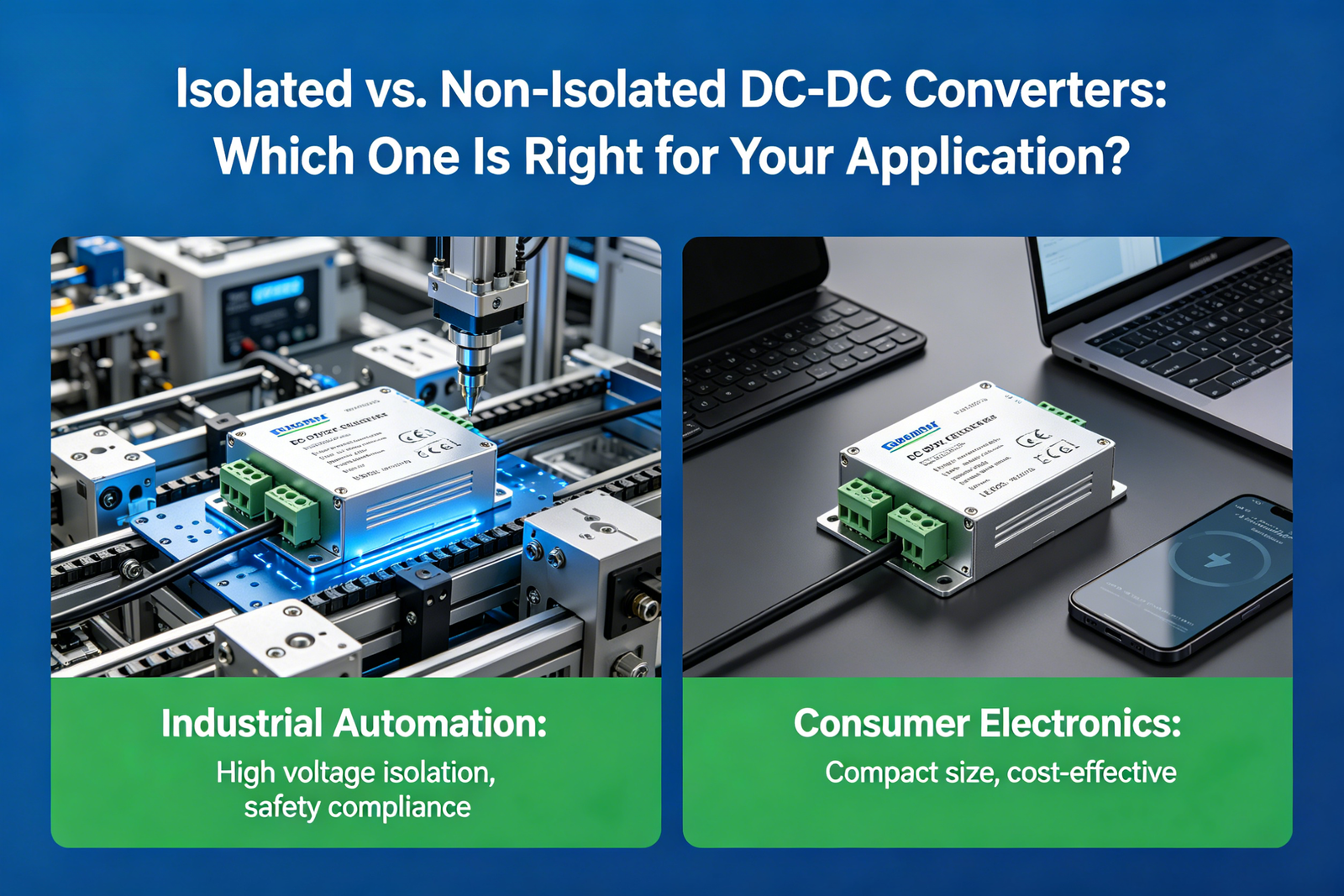
Isolated vs. Non-Isolated DC-DC Converters: Which One Is Right for Your Application?
Isolated vs. Non-Isolated DC-DC Converters: Which One Is Right for Your Application?
📅 Updated: April 2026 | ⏱ 9 min read | 🔌 Power Conversion
When designing a power supply system, one of the most fundamental decisions is whether to use an isolated DC-DC converter or a non-isolated DC-DC converter. The choice affects safety, efficiency, cost, complexity, and electromagnetic interference (EMI). In this guide, we’ll explain the key differences between isolated and non-isolated topologies, their respective advantages and disadvantages, and help you determine which type is right for your application—whether it’s automotive, industrial, medical, solar, or battery management.
What Is Galvanic Isolation?
Galvanic isolation means that there is no direct electrical connection between the input and output circuits of a converter. Instead, energy is transferred via a magnetic field (transformer) or an electric field (capacitor). In DC-DC converters, isolation is almost always achieved using a high-frequency transformer. This transformer provides a physical barrier that blocks DC current and common-mode noise while allowing AC power to pass through via magnetic coupling.
Isolated converters incorporate this transformer, while non-isolated converters have a direct electrical path between input and output (they share a common ground). The presence or absence of this transformer profoundly impacts performance, safety, and application suitability.
Key Differences at a Glance
| Feature | Isolated DC-DC Converter | Non-Isolated DC-DC Converter |
|---|---|---|
| Galvanic isolation | ✅ Yes (transformer) | ❌ No (common ground) |
| Safety | High – protects against ground loops and high-voltage shocks | Low – ground loops possible |
| Input/output voltage ratio | Can be very high or very low (transformer turns ratio) | Limited (buck: Vout < Vin; boost: Vout > Vin) |
| Efficiency | Slightly lower (transformer losses, extra components) | Higher (no transformer losses) |
| Size & cost | Larger, more expensive (transformer, optocoupler) | Compact, lower cost |
| Common topologies | Flyback, forward, push-pull, full-bridge, half-bridge | Buck, boost, buck-boost, SEPIC, Cuk |
💡 Did you know? Isolated converters are required by safety standards (e.g., IEC 60601 for medical equipment, UL 60950 for IT equipment) when the output must be isolated from the AC mains to protect users from electric shock.
Isolated DC-DC Converters: Advantages and Use Cases
An isolated DC-DC converter uses a transformer to separate input and output grounds. This offers several critical benefits:
- Safety: Prevents electric shock in case of a fault. Essential for medical devices (patient-connected equipment) and any system powered by AC mains.
- Ground loop elimination: Breaks unwanted circulating currents between different system grounds, improving signal integrity and reducing noise.
- Voltage scaling flexibility: The transformer turns ratio allows very high step-up or step-down ratios that would be inefficient or impossible with non-isolated topologies.
- Common-mode noise reduction: The transformer blocks low-frequency common-mode noise, making isolated converters suitable for sensitive analog and measurement circuits.
- Multiple outputs: A single transformer can provide several isolated outputs (e.g., +5V, +12V, -12V) with separate grounds.
Typical applications include:
- Medical equipment (patient isolation)
- Industrial automation and PLCs (noise immunity)
- Telecommunications (48V to 12V or 5V with isolation)
- Electric vehicles (battery-to-auxiliary isolation)
- Offline flyback power supplies (AC-DC conversion)
- Battery management systems (cell voltage monitoring)
Popular isolated topologies: flyback converter (for low power, 1–150W), forward converter (50–300W), and full-bridge (500W+).
Non-Isolated DC-DC Converters: Advantages and Use Cases
Non-isolated converters (buck, boost, buck-boost, SEPIC) have a direct current path between input and output. They are simpler, cheaper, and more efficient because they lack a transformer. However, they do not provide galvanic isolation.
Key benefits:
- Higher efficiency: No transformer core or copper losses; typically 90–97% efficiency.
- Lower cost and smaller size: Fewer components, no transformer, and no optocoupler feedback loop.
- Simpler control loop: Easier to stabilize, especially in buck and boost configurations.
- Better transient response: Lower output impedance due to direct coupling.
Typical applications include:
- Point-of-load (POL) regulation on PCBs (12V to 5V/3.3V/1.8V)
- Battery-powered devices (single ground reference)
- LED drivers (non-isolated buck or boost)
- Automotive electronics (12V to 5V for USB chargers, sensors)
- Solar charge controllers (MPPT tracking with common ground)
Common non-isolated topologies: buck converter (step-down), boost converter (step-up), and buck-boost converter (inverting or non-inverting).
How to Choose: Key Decision Factors
1. Safety Requirements
If your application involves human contact (medical devices, consumer electronics with exposed outputs) or operates from hazardous voltages (AC mains, >60V DC), safety standards almost always mandate galvanic isolation. For low-voltage battery-powered devices (e.g., 12V to 5V converter inside a car), non-isolated is acceptable.
2. Ground Loop and Noise Issues
In systems where multiple power supplies share a common ground or where analog signals are sensitive to ground noise, isolation breaks problematic ground loops. For instance, in battery monitoring systems (BMS), cell voltage measurement requires isolation between the high-voltage battery stack and the low-voltage control circuitry. An isolated DC-DC converter or dc dc isolator is essential here.
3. Voltage Ratio
If you need a very high step-up ratio (e.g., 12V to 300V) or step-down ratio (e.g., 400V to 12V), an isolated topology (flyback, forward) is usually the only practical choice. For moderate ratios (e.g., 24V to 12V, 12V to 5V), a non-isolated buck converter is more efficient and cost-effective.
4. Efficiency and Cost
For high-volume, cost-sensitive, and space-constrained applications (e.g., USB chargers, LED lighting, consumer electronics), non-isolated converters are preferred when safety permits. For industrial, medical, or automotive applications where isolation is mandatory, the added cost and size of isolation are justified.
5. Multiple Output Voltages
If you need several output voltages (e.g., +5V, +12V, -12V) from a single input, an isolated converter with a multi-winding transformer can provide them with a single magnetic component. Non-isolated converters would require separate regulators for each output.
⚠️ Important: Never use a non-isolated converter in applications where the output ground could become live relative to earth or where user access is possible. Always follow your industry’s safety standards.
Isolated vs. Non-Isolated DC-DC Chargers and BMS
In battery management and charging systems, the choice between isolated and non-isolated converters is critical. For dc to dc battery chargers used in RVs, boats, or solar systems, isolation prevents ground loops between the alternator/panel ground and the house battery ground. Many high-quality dc to dc chargers (e.g., Victron Orion, Sterling Power) are isolated for this reason. For low-cost automotive battery maintainers, non-isolated may suffice but lacks safety in fault conditions.
In Battery Management Systems (BMS) for electric vehicles, isolation is mandatory between the high-voltage battery stack (up to 800V) and the low-voltage communication and control circuits. Isolated DC-DC converters power the BMS board from the high-voltage pack while maintaining safe galvanic separation. Non-isolated converters would create a hazardous path.
Real-World Examples
- Electric vehicle (EV) DC-DC converter: Steps down 400V or 800V from the main battery to 12V for auxiliary systems. Must be isolated for safety (high voltage to low voltage). Topology: isolated full-bridge.
- 12V to 5V USB car charger: Non-isolated buck converter. The car’s chassis ground is the same as USB ground; isolation not required.
- Medical-grade power supply for patient monitor: Isolated flyback converter with 4kV isolation to meet IEC 60601-1.
- 48V to 12V converter for golf cart lights: Non-isolated buck converter (common ground). Acceptable because both 48V and 12V share the battery negative.
- Solar charge controller with MPPT: Many modern controllers use non-isolated buck topology for 12V/24V systems, but higher-voltage systems (48V to 12V for loads) often use isolated converters to prevent ground loops with the PV array.
Conclusion: Making the Right Choice
The decision between an isolated DC-DC converter and a non-isolated DC-DC converter boils down to safety requirements, ground loop sensitivity, voltage ratio, and cost constraints. Use isolation when:
- Safety standards demand it (medical, mains-powered, human-accessible outputs).
- You need to break ground loops or prevent common-mode noise interference.
- You require very high step-up/down ratios or multiple isolated outputs.
- You are designing a BMS for EV or high-voltage battery systems.
Use non-isolated when:
- Input and output share a common ground and low voltage (<60V).
- Efficiency, cost, and size are top priorities.
- The application is a simple point-of-load regulator (e.g., 12V to 5V).
By carefully evaluating your application’s safety, electrical environment, and performance needs, you can confidently select the right topology. When in doubt, err on the side of isolation—it adds a layer of safety and noise immunity that often proves worthwhile in the long run. © 2026 Power Electronics Guide – Your resource for isolated vs non-isolated DC-DC converters, converter topologies, and power supply design.