

Blog
LiFePO4 Battery Management Systems (BMS): Why You Need One for Your 12V Lithium Battery

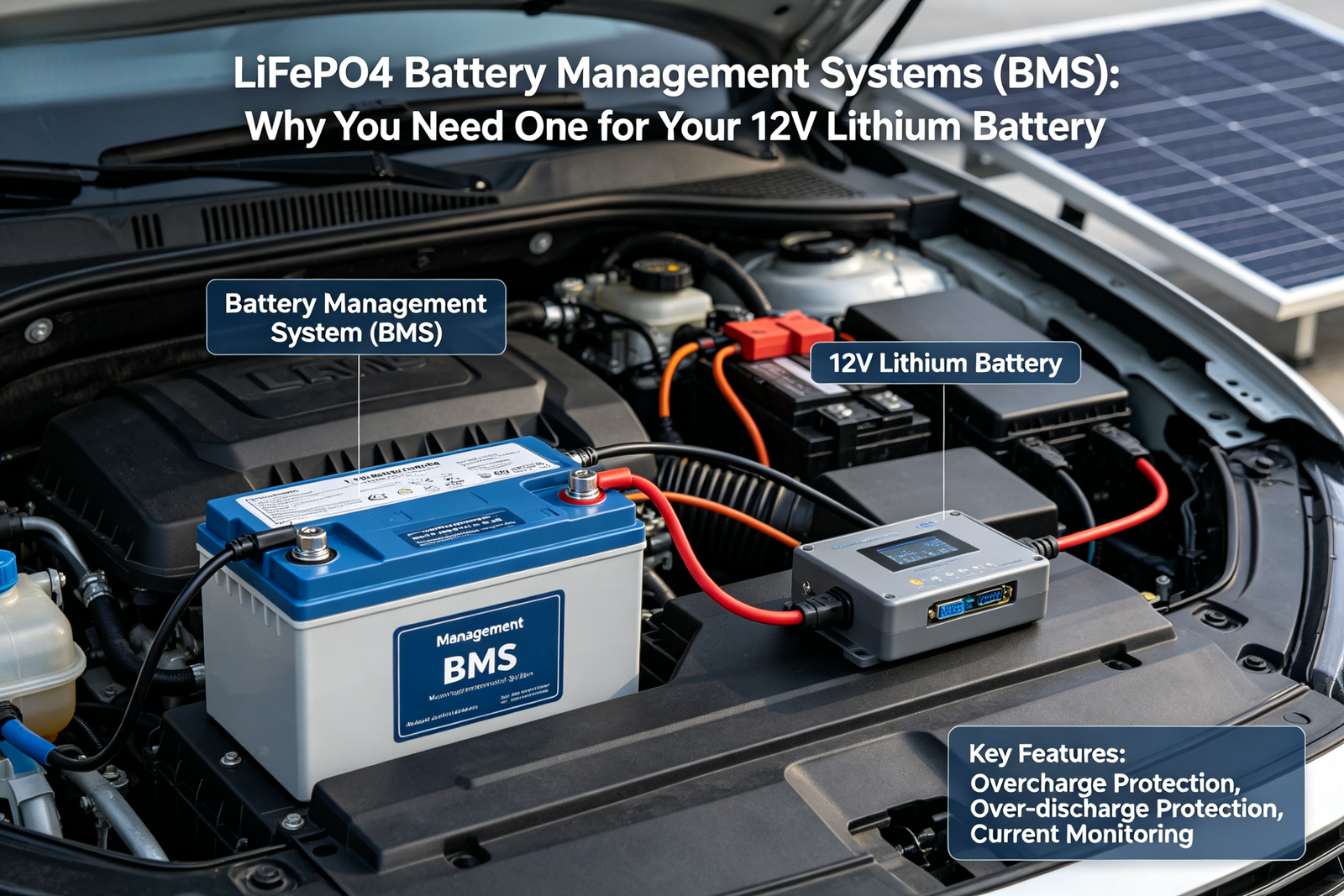
LiFePO4 Battery Management Systems (BMS): Why You Need One for Your 12V Lithium Battery
LiFePO4 Battery Management Systems (BMS): Why You Need One for Your 12V Lithium Battery
📅 Updated: April 2026 | ⏱ 10 min read | 🔋 Battery Technology
Lithium iron phosphate (LiFePO4) batteries have revolutionized energy storage for RVs, solar systems, golf carts, marine applications, and off-grid living. They are lighter, last longer, and deliver more usable capacity than lead-acid batteries. But unlike traditional batteries, a LiFePO4 battery absolutely requires a Battery Management System (BMS) to operate safely and reliably. In this guide, we explain what a BMS does, why every 12V lithium battery needs one, and how to choose the right BMS for your application.
What Is a Battery Management System (BMS)?
A Battery Management System (BMS) is an electronic circuit that monitors and controls the operation of a lithium battery pack. It acts as the brain of the battery, ensuring that each cell operates within safe voltage, current, and temperature limits. For a 12V LiFePO4 battery, which typically consists of four 3.2V cells connected in series (4S configuration), the BMS continuously measures individual cell voltages, total pack voltage, charge/discharge currents, and internal temperature. If any parameter exceeds a preset threshold, the BMS instantly disconnects the battery from the charger or load to prevent damage or hazardous conditions.
💡 Key fact: Unlike lead-acid batteries that can tolerate some overcharging and deep discharging, LiFePO4 cells are highly sensitive. Operating outside their safe voltage range (typically 2.5V to 3.65V per cell) can permanently reduce capacity or cause thermal runaway. A BMS is not optional—it is a mandatory safety device.
Why Your 12V LiFePO4 Battery Needs a BMS
Without a BMS, a lithium battery is a ticking time bomb. Here are the critical protection functions a BMS provides:
🔋 Overcharge Protection
If a LiFePO4 cell exceeds 3.65V, irreversible damage occurs. The BMS disconnects the charger when any cell reaches the maximum voltage, preventing overcharge even if the charger malfunctions.
🔋 Over-discharge Protection
Discharging below 2.5V per cell damages the internal structure. The BMS cuts off the load before the voltage drops dangerously low, preserving battery life.
⚖️ Cell Balancing
Over time, cells can drift apart in voltage. A BMS with passive balancing shunts a small amount of current from higher-voltage cells to equalize them, maximizing usable capacity.
🌡️ Temperature Protection
Charging LiFePO4 below freezing (0°C / 32°F) can cause lithium plating and permanent damage. Many BMS units include low-temperature cutoff to prevent charging in cold conditions.
⛓️ Short Circuit & Overcurrent Protection
A sudden short circuit can deliver thousands of amps. The BMS detects excessive current and disconnects the battery in microseconds, preventing fires and equipment damage.
How a BMS Works: A Simple Explanation
Most 12V LiFePO4 BMS boards are designed for 4-series cells (4S). They connect to each cell junction via small sense wires. The BMS contains:
- Analog Front End (AFE): Measures individual cell voltages, pack voltage, and current (via a shunt resistor).
- Microcontroller (MCU): Executes protection algorithms and controls MOSFET switches.
- MOSFET switches: Two banks of MOSFETs—one for charge (CH-) and one for discharge (DC-)—allow independent control of charging and discharging paths.
- Balancing resistors: For passive balancing, each cell has a bypass resistor that can be switched on to drain excess voltage.
When all conditions are normal, the BMS keeps both MOSFET banks closed (conducting), allowing current to flow freely. If a fault occurs, the corresponding MOSFET bank opens, isolating the battery. After the fault is cleared (e.g., overcurrent removed, temperature returns to normal), most BMS units automatically re-close the MOSFETs, though some require a reset or charger connection.
Different Types of BMS for 12V LiFePO4 Batteries
1. Common Port vs. Separate Port
- Common port BMS: Uses the same two wires (P+ and P-) for both charging and discharging. Simpler wiring but may have lower current ratings.
- Separate port BMS: Has separate charge (C-) and discharge (D-) terminals. Allows higher continuous current and independent control, often used in high-power applications.
2. Standard BMS vs. Smart BMS (Bluetooth)
- Standard BMS: Basic protection with fixed parameters; no user monitoring.
- Smart BMS (Bluetooth): Connects to a smartphone app, allowing real-time monitoring of each cell voltage, current, temperature, cycle count, and customizable protection thresholds. Highly recommended for users who want full visibility.
3. Continuous Current Ratings
BMS units are rated by maximum continuous discharge current. For a 12V 100Ah battery, a 100A BMS is common. For larger loads (inverters up to 2000W), a 200A BMS may be required. Always choose a BMS rated at least 20% higher than your expected peak load.
⚠️ Critical: Low-Temperature Charging Protection
Many cheap BMS units lack low-temperature cutoff. If you plan to charge your LiFePO4 battery in freezing conditions, you must buy a BMS with built-in temperature sensors and low-temp protection. Otherwise, you risk permanently destroying your battery.
Signs Your BMS Is Failing (or Missing)
- Battery won’t charge fully: Stops at 13.6V instead of 14.4V—possible BMS overcharge protection triggering early.
- Sudden power loss: BMS disconnects under heavy load due to overcurrent or cell voltage sag.
- Cells are severely unbalanced: After charging, one cell is above 3.65V while others are below 3.4V—balancing circuit may be defective.
- Battery gets hot during charging: Could indicate a shorted MOSFET or missing thermal protection.
If your battery did not come with a BMS (some raw cell packs), do not use it. Purchase a suitable BMS and install it immediately. For pre-assembled “drop-in” LiFePO4 batteries, always verify that the manufacturer includes a BMS with low-temperature cutoff.
How to Choose the Right BMS for Your 12V LiFePO4 Battery
- Determine your continuous discharge current: Add up all loads (inverter, lights, fridge, etc.). For a 2000W inverter at 12V, continuous current ≈ 2000W / 10V (low voltage cutoff) ≈ 200A. Choose a 250A BMS for safety margin.
- Check charge current: Your solar charge controller or alternator may deliver up to 50A. Ensure the BMS’s charge current rating meets or exceeds that.
- Look for low-temperature cutoff: Essential if you live in a cold climate or use the battery outdoors in winter.
- Decide on Bluetooth monitoring: For DIY builders, a smart BMS with Bluetooth is invaluable for troubleshooting and performance tracking.
- Confirm cell configuration: 12V LiFePO4 uses 4S (4 cells in series). Some BMS are also available for 8S (24V) or 16S (48V).
🔧 Pro tip: When building your own LiFePO4 battery pack, choose a BMS with a continuous current rating 25–50% higher than your maximum expected load. MOSFETs run cooler, and the BMS will last longer. Also, ensure the balancing current is at least 50mA for larger cells (100Ah+).
BMS vs. Battery Monitor: What’s the Difference?
A BMS is a protection device—it disconnects the battery under fault conditions. A battery monitor (e.g., Victron SmartShunt, Renogy Battery Monitor) is a measurement device that shows state of charge, voltage, current, and historical data but does NOT disconnect the battery. For complete safety and monitoring, you need both: a BMS for protection and a battery monitor for user feedback. Some advanced smart BMS units combine basic monitoring features, but they are not as accurate as a dedicated shunt-based monitor.
Conclusion: Never Run a LiFePO4 Battery Without a BMS
A LiFePO4 battery offers incredible performance, but its safety and longevity depend entirely on a properly functioning Battery Management System. Whether you buy a ready-made 12V lithium battery or build your own pack, always verify that a BMS is included and that it provides overcharge, over-discharge, short circuit, overcurrent, and (crucially) low-temperature protection. Investing in a quality BMS—preferably a smart Bluetooth model—gives you peace of mind and maximizes the return on your battery investment. Don’t cut corners; the few extra dollars for a good BMS can save you hundreds in replacement cells and prevent potentially dangerous failures.
For off-grid solar, RV travel, marine use, or any application where reliability matters, a robust LiFePO4 BMS is not an option—it’s a necessity. © 2026 Energy Storage Guide – Your resource for LiFePO4 battery management systems, lithium battery safety, and 12V BMS selection.